
no - your mom friends don't want to make dinner for their kids right now, either
My husband, our two small children, our COVID19 antibodies, and I hopped in our SUV (prayed that our shaky brakes would not give out), and drove the 1,036 miles from the front door of our apartment in Bakersfield, CA to the porch of my childhood home in Seattle, WA last week.

Leaving behind triple digit temps, we sighed in relief at the forecast of 80F degrees in the Pacific Northwest, and sent out texts to our ever-dwindling list of friends to see while in town. At the top of my list was a fellow doula friend and her daughter (and their family); our daughters started playing together around six months old and they are both now turning the corner (Vin Diesel-style) on four years of age.
My friend and I used to share doula clients - she worked two days a week for a family, and I worked the other two days. While one of us fulfilled our doula hours, the other watched both of our girls. It was the childcare arrangement of my Marxist dreams. If my family did not have to relocate out of state because of the COVID19 pandemic, I am sure my friend and I would be bouncing childcare and clients back and forth to some capacity today.
This friend is about a decade older and wiser than me. She has had more years of talk therapy, for one thing. I look to her as an example of the kind of parent (mom) I thought I was going to be before I gave birth to my first child. She seems more patient, centered, present, and her child gets less screen time and fast food. A saint among us, if you ask me.
This perception - seeing another parent or mom with IG goggles (meaning you gather a one-dimensional snapshot of their parenting skills, and only use these observations for comparison) - is what keeps me tight-lipped about my parenting struggles. I have felt completely knocked ashore, disoriented and in pain, by the wave of new responsibilities and stress thrust upon me by this pandemic. And I assumed this was a personal failure of mine.
Because of the functions and nature of the nuclear family model in the United States, parents (usually women) are given limited options for balancing work and childcare. As of 2019, 55 percent of mothers with children work full time and 72 percent are employed to varying degrees. In two parent households, 46 percent of those couples both work full time. According to the same survey, no matter the employment status of both parents, in the majority of those households, mothers took on more childcare and domestic labor responsibilities.
For women of color, especially Black women, staying home with your child is rarely an option. Why? Because of structural racism, Black family dynamics in the United States look different than their white counterparts. Black women, historically and currently, must work outside of the home to provide for their families - more than two thirds of working Black mothers are single.
Black households also have lower rates of state-sanctioned marriage. Why? Because of systemic racism; higher representation of Black women than men in the work force, lack of stable and well-paying employment for both Black men and women, and the disproportionate rate of incarceration of Black men. (Marriage is fundamentally an economic contract, and partners are less eligible if they are in prison, or do not have stable financial standing.)
In 2021, 64 percent of Black children live in single-parent households - although, this does not take into consideration the various household structures in the Black community, including cohabiting, coparenting, and multigenerational homes. The racist public perception of Black families is statistically incorrect - 60 percent of Black children live with their fathers, and Black family structures in the United States more often reflect arrangements similar to those before European colonization (like extended family and kin networks). Black families also report more egalitarian divisions of domestic labor -Black fathers are also more likely than fathers of other races to preform childcare tasks for their children.
For poor women, working class women, and the women that live at the intersection of marginalized race and class, caring for children typically means caring for someone else's for pay, while you scramble to find an affordable option for your own children's care (what the fuck?).
So if these are the numbers we are walking into the COVID19 pandemic with - overall, women doing more childrearing than men and the majority of stay-at-home parents being women - what happens when the other 80-some percent of parents must now, too, be parenting their child alone, in their home, for ten hours a day. (And some even trying to work at the same time?!)
The isolation of caring for children in the United States, or any dependent person, is excruciating. And the intensity of that isolation was exacerbated by the COVID19 pandemic. Working parents (usually moms), and other caregivers, were forced to leave jobs or other productive (in the Marxist sense) responsibilities, and head home to care for their children or dependents. Childcare was, quite literally, suddenly no longer a function of the state (free state-sponsored preschool and public schools), or a daycare facility, or community (nannies, childcare shares, family), for the percentage of people that could afford it or have access to it in the first place. Some studies say that less than 15 percent of U.S. families can truly afford childcare.
For those of us already spending the majority of our time caring for children, we reveled in the schadenfreude of watching the frustration and stress of people forced to stay home and/or care for their children full time, probably for the first time (yes -I am talking about fathers and parents who work outside of the home). Finally, we were validated. Seen. Understood. I saw the flashes of hope, flying beneath my thumb as I scrolled through the articles and social media posts about the difficulty of staying home with kids, or working from home, and how to cope. See, we told you it sucked! *Now* people will push for permanent change.
I am afraid that the momentum of a possible childcare revolution is starting to fade. Working parents that were outraged by having to take time off of work to help their children with virtual school, or work from home with toddlers screaming in the background, are being lured back into the collective hallucination that is capitalist consciousness, as our political leaders and bosses march us back into classrooms and offices with the promise of “returning to normal”.
Men were already the partner with the higher paying and stable job in most married families, and are further incentivized to continue their paid work if their wife was on one of the three million women who left the workforce during the pandemic. As our current economic crisis in the fallout of this health crisis continues, men, by force of their traditional gender role, will have to pick up the financial slack for the whole family, pulling them further from the drudgery of primary parenthood and stay at home life, quickly and silently yanking any investment in a childcare system overhaul from their perception (like the party trick where someone pulls the tablecloth off of the table, and none of the dishes or silverware move).
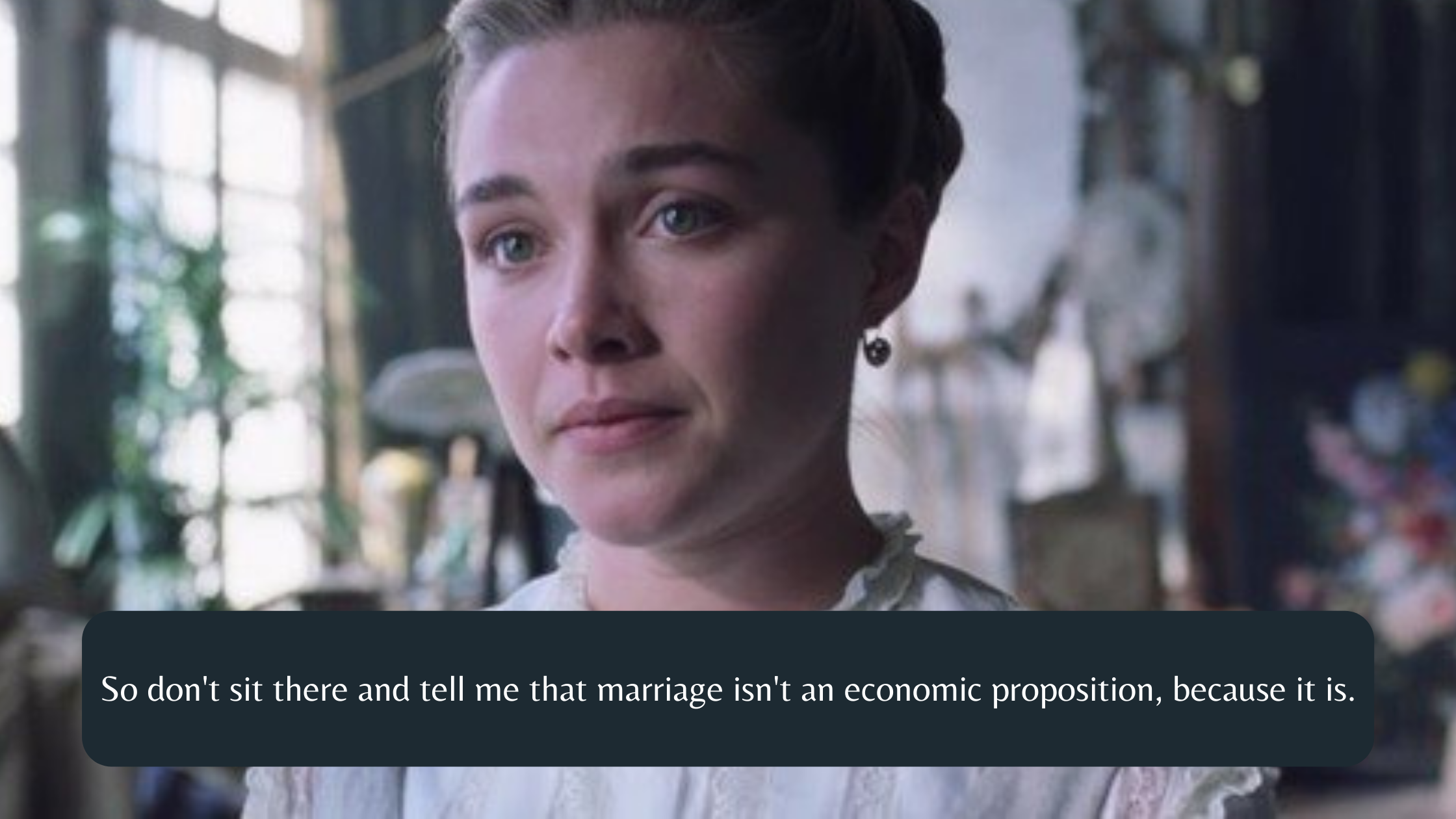
Florence Pugh as Amy March in Little Women (2019).
Ta-da! Jeff Bezos and all of the other billionaires who’s fortunes increased in 2020 want you to believe this nightmare never happened.
Childcare was difficult work before the COVID19 pandemic, and it will continue to be afterwards, unless we stop this train. As a primarily stay at home parent since the birth of my first baby (I am self-employed as postpartum doula), I can attest to the loneliness and the emotional and physical toll of childrearing on your own most of the time. The irony is that my profession exists because of this very fact - childcare is challenging and expensive (in terms of physical and emotional energy) work, and people with enough money hire people like me to help.
There have been many days, before this pandemic and during, where I have not had the energy or the will to get up and feed my children three meals a day. I do. But some days I order from a food delivery service, and my children thank me in jumping excitement for the Happy Meal they are eating for dinner. Some days I feed them the same foods all day - the ones they love (no arguments!) and that take minimal prep on my part. And I lay down on the bed and scroll through my phone, uninterrupted, for five minutes while they eat.
The worst part about our current meal system is not how difficult it feels, or the actual work of doing it - it's the shame I feel after. The shame of feeling that I am not a good enough mom, that I have fallen apart amidst the stress from the changes brought on by this pandemic. Alone in my house with my kids, with only my husband to witness my parenting and vent to, I assumed it was just me that was struggling to feed my kids every day.
Now I'm here, in the kitchen with my friend that I haven't seen in at least nine months. My friend who cooks healthy meals most of the time and doesn't let her child watch Raya and the Last Dragon back-to-back in the same day, I witness her and her parenting. It is her birthday. Her husband forgets to do the grocery pick up. Dinner will be later than they planned. He expresses he is not up for cooking. She tells him she isn't either. Her sister, who lives with them and is considered a third parent, is taking a work call and is unavailable to help. "Last night was her night to cook anyway," he tells us.
Among three adults, with a written-out domestic chore schedule, and jobs outside of the home, none of them want to make dinner. It's taco night, and having learned about flipping tortillas with my bare hands after marrying into a Mexican family, I am happy to jump in to help. As always, I'm hungry, anyway. My friend and I get to talk about doula work and our professional goals while we flip tortillas and cut limes.
I feel validated, seeing this household struggle to make dinner happen. This validation is organic too, because it's simply my observation (as opposed to me barfing up all of my feelings from a 12 hour day at home with the kids to my husband so I can be seen or whatever).
Parents staying home with children are doing work that tires three able-bodied adults out. To be done right (I mean hands-on, present parenting), this work is impossible on one's own. Parents do not need more self-help articles about how to take care of yourself with meditation and baths, the increasingly culturally accepted norm of Perinatal Mood and Anxiety Disorders (PMADS), or well-meaning comments on social media about "strong mamas". We need nationalized or universal childcare. Now. That is a step in the direction of abolishing nuclear families, and capitalism with it.
If I have to read another comment or post about "the village" that is not raising our kids, but that we so desperately need, I will simply vom. We know what children and families need, intuitively and from our experience and from research. Our entire communities will be better served and more livable if the care of dependents is a communal responsibility.
How did my friend's birthday dinner go from not getting done at all, to everyone enjoying tacos at the table together an hour later? Two adults cooked food together, and another adult was responsible for the children. That is community. That is the village. It is perfectly normal if you don't "feel" like doing all of the parenting tasks all of the time. Nobody does. But if you are a primary caregiver, you likely do not have a choice. That is not your fault.
Care tasks, domestic labor, and childcare are the responsibility of every living person. There are necessary for daily human function and life. Because of capitalism and its cultural values and societal demands - most of our daily hours doing paid productive labor for low wages, mainly - we have forced these immense responsibilities on groups of people as a way to marginalize them. The COVID19 pandemic showed swaths of people, formerly untouched, ignorant, or privileged (or all three) by this societal contract that: this work has to be done, someone has to do it, it is fucking impossible to do (well) by yourself, and without it, all other jobs cannot be done.
Parents and caregivers make the world go round. We deserve something to show for it. And if we don't have the energy (or the money or the time) to make dinner for our children and dependents, there should be a village waiting outside our door to help.